
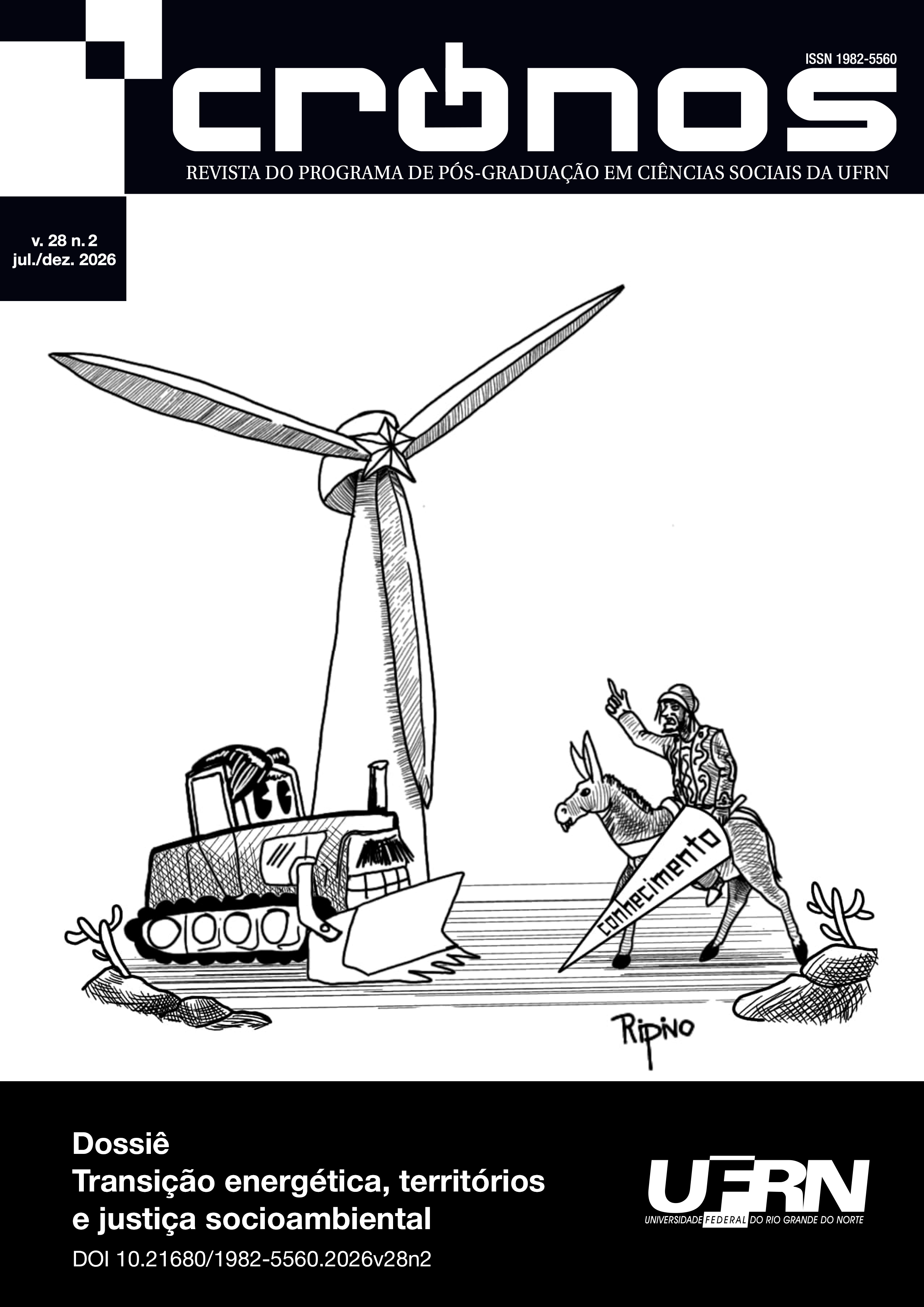
Eólicas offshore no litoral do Rio Grande do Norte e conflitos socioambientais em potencial
DOI:
https://doi.org/10.21680/1982-5560.2026v27n2ID43827Palavras-chave:
Energia Eólica Offshore, Pesca artesanal, Conflitos socioambientaisResumo
Este trabalho caracteriza o contexto inaugural de implementação de aerogeradores offshore no Brasil, com foco no litoral de Areia Branca, Rio Grande do Norte. A análise centra-se na constituição de uma “arena pública” (Cefaï 2011) de negociações entre atores econômicos, políticos e sociais em torno dos impactos socioambientais sobre quatro comunidades de pescadores artesanais: Morro Pintado, Redonda, Cristóvão e Ponta do Mel. O estudo utiliza-se da observação participante e de relatos de experiências derivados de um projeto de extensão universitária (CRDH/Semiárido) que oferece assessoria jurídica popular às comunidades impactadas. Discutem-se as tensões entre o plano nacional de transição energética, sob a égide do neoextrativismo, e a proteção dos territórios tradicionais garantida pela PNPCT. Os resultados parciais revelam assimetrias de poder nos ritos de participação democrática, onde o uso de linguagens técnicas por agentes do setor privado e a intermediação de lideranças locais buscam legitimar o licenciamento ambiental. Observa-se que, enquanto o setor privado foca na viabilidade técnica do "Sítio de Testes", os pescadores manifestam receios quanto à perda de rotas de pesca e à precarização de seus modos de vida, demandando processos de Consulta Livre, Prévia e Informada (CLPI).
Downloads
Downloads
Publicado
Como Citar
Edição
Seção
Licença
Copyright (c) 2026 Revista Cronos

Este trabalho está licenciado sob uma licença Creative Commons Attribution-NonCommercial-ShareAlike 4.0 International License.
 English
 Español (España)
 Português (Brasil)