RELATIONSHIPS BETWEEN ANTHROPOLOGY, FEMINISM AND HUMAN RIGHTS:
EXPERIENCES OF COMMUNITY EXTENSION BEFORE ITS MANDATORY CURRICULUM IN BRAZILIAN UNIVERSITIES
DOI:
https://doi.org/10.21680/2238-6009.2024v1n63ID35769Abstract
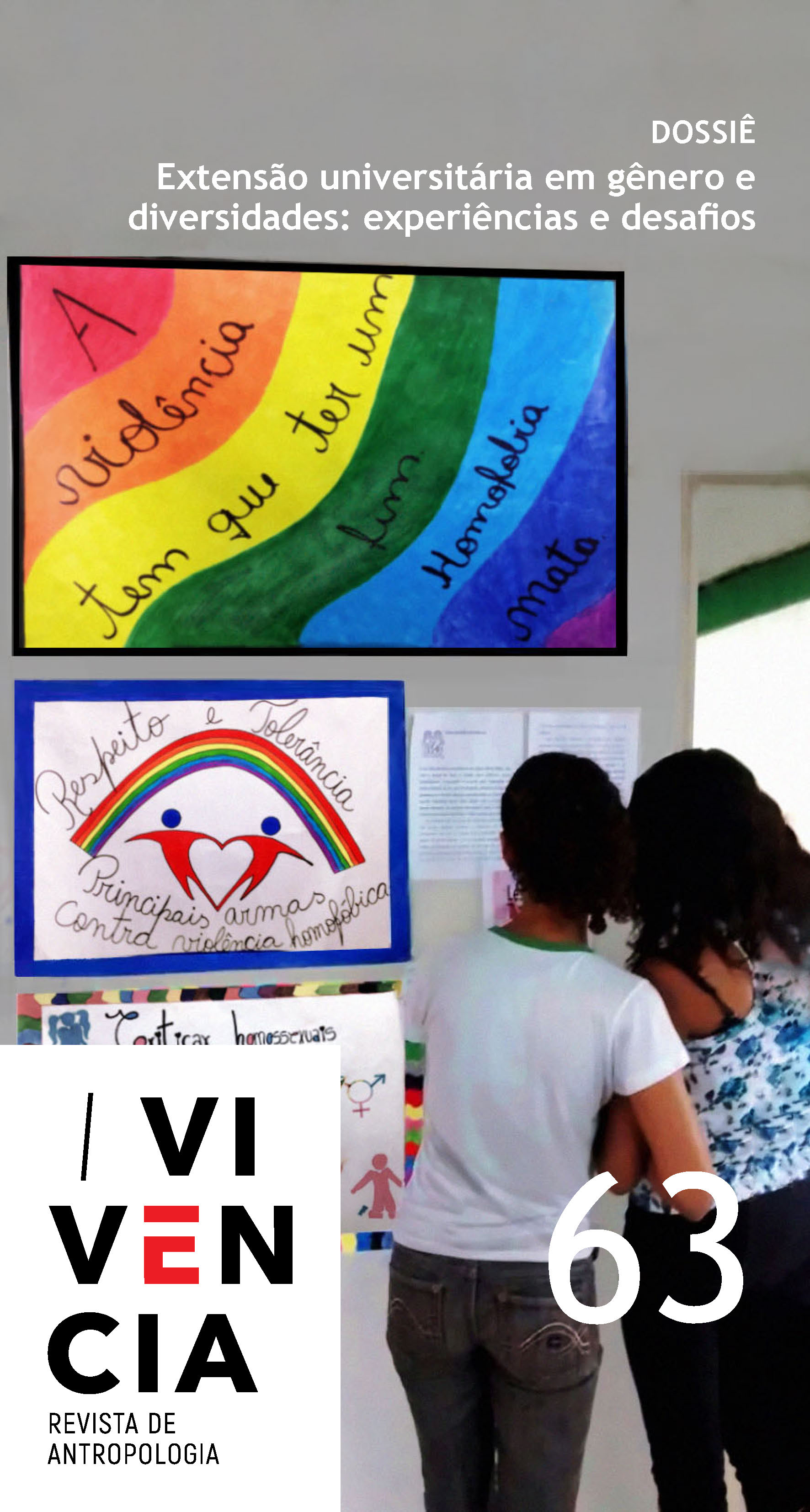
This article aims to reflect on different extension practices carried out in three Brazilian universities: UNIPLAC, UFRN and UFV-MG, prior to the mandatory formal community extension curriculum. We seek to demonstrate how community extension programs constitute an essential element for the development of teaching and research in the academic context. We are based on qualitative community-based research, of an ethnographic nature, and describe four extensionist practices that are based on our experience: 1) affirmation of ethnic identities; 2) reflections on gender-based violence in basic education schools; 3) the integration between teaching-service-community in health and 4) reproductive and women's rights. Such actions contribute to reflexivity based on the agency of the subjects with regard to the exercise of citizenship. This community extension, according to the “Niguian” conception, promotes interdisciplinarity, scientific rigor, dialogue between knowledge produced in academia and communities, in an intersectional perspective, valuing different knowledge, affections, feminisms and fundamental human rights .
Downloads
Downloads
Published
How to Cite
Issue
Section
License
Copyright (c) 2025 Rozeli Maria Porto, Cleiton, Mareli, Marcelo

This work is licensed under a Creative Commons Attribution-NonCommercial-ShareAlike 4.0 International License.
 Português (Brasil)
 English
 Español (España)
 Français (Canada)