Information organization and preservation about Resident Evil 3: Nemesis (PS1) in community repositories
a comparative analysis of RE Wiki and REVIL
DOI:
https://doi.org/10.21680/2447-0198.2026v10n1ID43199Keywords:
knowledge organization, digital preservation, metadata, digital objects, World Wide WebAbstract
Introduction: Community game repositories act as paratextual layers that organize and stabilize knowledge about digital games, shaping findability, interpretation, and informational memory. Objective: To comparatively analyze how the Resident Evil Wiki (Fandom) and the Brazilian portal REVIL organize and document information about Resident Evil 3: Nemesis (PS1, 1999), focusing on representation structures and documentary preservation cues. Methodology: Qualitative, documentary, descriptive-analytical research using a case-study approach and cross-platform comparison. The corpus includes structured pages (infoboxes, categories, lists, entries, and walkthroughs) and, when available, editorial histories; analysis examines representation patterns (attributes, relations, hierarchies) and contrasts observed elements with digital preservation references such as OAIS and PREMIS. Results: RE Wiki exhibits an encyclopedic organization, strong template-based standardization, and high semantic connectivity, supporting retrieval through entity relations and domain decomposition. REVIL combines thematic curation and procedural content (guides), providing use-oriented mediation for a Brazilian audience, with provenance signals such as dates and partial editorial responsibility. Conclusion: Both repositories play complementary roles in the game’s informational memory, yet show gaps in formal preservation metadata, reinforcing the need to debate minimal provenance, versioning, and contextual requirements to mitigate long-term vulnerabilities in community collections.
Downloads
References
AARSETH, Espen J. Cybertext: perspectives on ergodic literature. Baltimore, MD: Johns Hopkins University Press, 1997. Disponível em: https://dl.acm.org/doi/book/10.5555/265941. Acesso em: 1 mar. 2026.
BARDIN, Laurence. Análise de conteúdo. São Paulo: Edições 70, 2016.
BOGOST, Ian. Unit operations: an approach to videogame criticism. Cambridge, MA: The MIT Press, 2006. Disponível em: https://philpapers.org/rec/BOGUOA. Acesso em: 2 mar. 2026.
BUCKLAND, Michael K. Information as thing. Journal of the American Society for Information Science, v. 42, n. 5, p. 351-360, June 1991. DOI: https://doi.org/10.1002/(SICI)1097-4571(199106)42:5%3C351::AID-ASI5%3E3.0.CO;2-3. Disponível em: https://asistdl.onlinelibrary.wiley.com/doi/10.1002/%28SICI%291097-4571%28199106%2942%3A5%3C351%3A%3AAID-ASI5%3E3.0.CO%3B2-3. Acesso em: 2 mar. 2026.
BUSHEY, Jessica. A participatory archives approach to fostering connectivity, increasing empathy, and building resilience during the COVID-19 pandemic. Heritage, San José, v. 6, n. 3, p. 2379-2393, Feb. 2023. DOI: https://doi.org/10.3390/heritage6030125. Disponível em: https://www.mdpi.com/2571-9408/6/3/125. Acesso em: 21 maio 2026.
CELLARD, André. A análise documental. In: POUPART, Jean et al. A pesquisa qualitativa: enfoques epistemológicos e metodológicos. Petrópolis: Vozes, 2008. p. 295-316. Disponível em: https://pt.scribd.com/document/522749043/POUPART-Jean-Et-Alii-a-Pesquisa-Qualitativa-Enfoques-Epistemologicos-e-Metodologicos. Acesso em: 2 mar. 2026.
GENETTE, Gérard. Paratexts: thresholds of interpretation. Cambridge: Cambridge University Press, 1997. Disponível em: https://books.google.com/books/about/Paratexts.html?id=AmWhQzemk2EC. Acesso em: 3 mar. 2026.
GIEREND, Kerstin; KRÜGER, Frank; GENEHR, Sascha; HARTMANN, Francisca; SIEGEL, Fabian; WALTEMATH, Dagmar; GANSLANDT, Thomas; ZELEKE, Atinkut Alamirrew. Provenance information for biomedical data and workflows: scoping review. Journal of Medical Internet Research, v. 26, e51297, Aug. 2024. DOI: https://doi.org/10.2196/51297. Disponível em: https://www.jmir.org/2024/1/e51297/. Acesso em: 21 maio 2026.
GOLDER, Scott A.; HUBERMAN, Bernardo A. Usage patterns of collaborative tagging systems. Journal of Information Science, v. 32, n. 2, p. 198-208, Apr. 2006. DOI: https://doi.org/10.1177/0165551506062337. Disponível em: https://journals.sagepub.com/doi/10.1177/0165551506062337. Acesso em: 3 mar. 2026.
GRAY, Jonathan. Show sold separately: promos, spoilers, and other media paratexts. New York: New York University Press, 2010. Disponível em: https://nyupress.org/9780814731956/show-sold-separately/. Acesso em: 3 mar. 2026.
HJØRLAND, Birger. Domain analysis in information science: eleven approaches – traditional as well as innovative. Journal of Documentation, v. 58, n. 4, p. 422-462, Aug. 2002. DOI: https://doi.org/10.1108/00220410210431136. Disponível em: https://www.emerald.com/jd/article-abstract/58/4/422/208322/Domain-analysis-in-information-scienceEleven?redirectedFrom=fulltext. Acesso em: 4 mar. 2026.
INTERNATIONAL ORGANIZATION FOR STANDARDIZATION. ISO 14721:2012: Space data and information transfer systems. Open archival information system (OAIS) — reference model, Issue 2. Geneva: ISO, 2012. Disponível em: https://www.iso.org/standard/57284.html. Acesso em: 4 mar. 2026.
JENKINS, Henry. Confronting the challenges of participatory culture: media education for the 21st century. Chicago: The MacArthur Foundation, 2009. Disponível em: https://www.macfound.org/media/article_pdfs/jenkins_white_paper.pdf. Acesso em: 5 mar. 2026.
JENKINS, Henry. Convergence culture: where old and new media collide. New York: New York University Press, 2006.
JUUL, Jesper. Half-real: video games between real rules and fictional worlds. Cambridge, MA: The MIT Press, 2005. Disponível em: https://mitpress.mit.edu/9780262516518/half-real/. Acesso em: 5 mar. 2026.
LOWOOD, Henry; MONNENS, Devin; VOWELL, Zach; RUGGILL, Judd Ethan; MCALLISTER, Ken S.; ARMSTRONG, Andrew. Before it’s too late: a digital game preservation white paper. American Journal of Play, v. 2, n. 2, p. 139-166, Fall 2009. Disponível em: https://files.eric.ed.gov/fulltext/EJ1069232.pdf. Acesso em: 5 mar. 2026.
NEWMAN, James. Best before: videogames, supersession and obsolescence. London: Routledge, 2012. DOI: https://doi.org/10.4324/9780203144268. Disponível em: https://www.taylorfrancis.com/books/mono/10.4324/9780203144268/best-james-newman. Acesso em: 6 mar. 2026.
NEWMAN, Michele; FAVORS, Drew; KOUGHAN, Lane; LEE, Jin Ha. Participatory media and game preservation: a taxonomy of YouTube game-related content. Proceedings of the Association for Information Science and Technology, v. 61, n. 1, p. 277-289, Oct. 2024. DOI: https://doi.org/10.1002/pra2.1027. Disponível em: https://asistdl.onlinelibrary.wiley.com/doi/10.1002/pra2.1027. Acesso em: 21 maio 2026.
PREMIS EDITORIAL COMMITTEE. PREMIS data dictionary for preservation metadata. Version 3.0. Washington, DC: Library of Congress, 2015. Disponível em: https://www.loc.gov/standards/premis/v3/premis-3-0-final.pdf. Acesso em: 6 mar. 2026.
RESIDENT EVIL 3: NEMESIS. [S. l.]: Capcom, 1999. 1 CD-ROM (PlayStation).
RESIDENT EVIL WIKI. Nemesis-T Type. [2026b]. Disponível em: https://residentevil.fandom.com/wiki/Nemesis-T_Type. Acesso em: 6 mar. 2026.
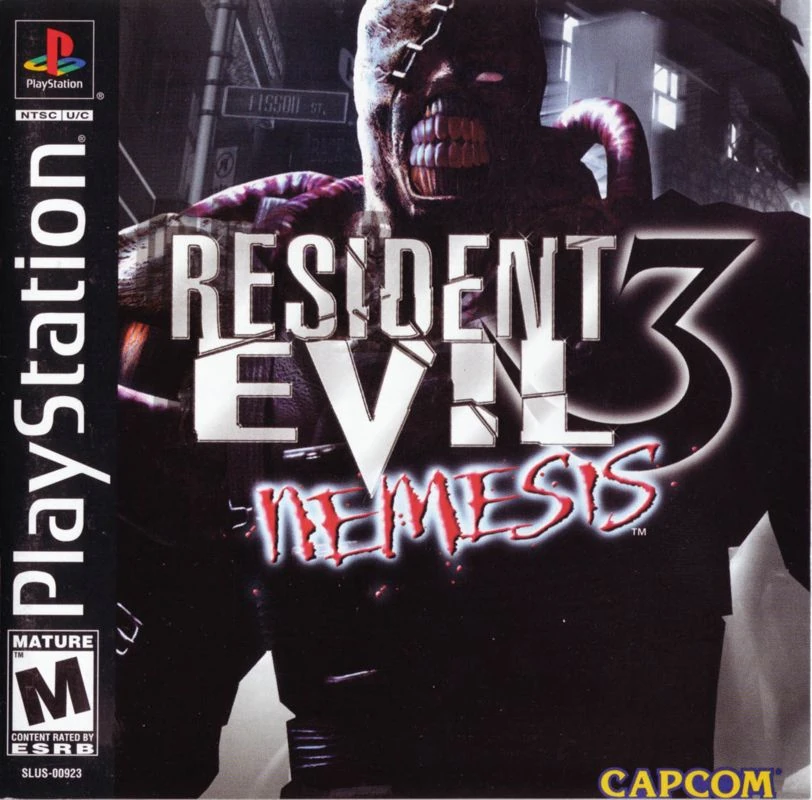
RESIDENT EVIL WIKI. RE_3_PS_NTSC.jpg: capa de Resident Evil 3: Nemesis (PS1, NTSC). 1 jun. 2023. 1 imagem, color. Disponível em: https://static.wikia.nocookie.net/residentevil/images/d/dc/RE_3_PS_NTSC.jpg/revision/latest?cb=20230601161231. Acesso em: 8 mar. 2026.
RESIDENT EVIL WIKI. Resident Evil 3: Nemesis. [2026a]. Disponível em: https://residentevil.fandom.com/wiki/Resident_Evil_3:_Nemesis. Acesso em: 6 mar. 2026.
REVIL. Guias: Resident Evil 3. [2011]. Disponível em: https://residentevil.com.br/resident-evil-3/guias/. Acesso em: 7 mar. 2026.
REVIL. Jill Valentine. 9 jul. 2015b. Disponível em: https://residentevil.com.br/wiki/jill-valentine/. Acesso em: 7 mar. 2026.
REVIL. Nemesis T-Type. 15 jul. 2015a. Disponível em: https://residentevil.com.br/wiki/nemesis-t-type/. Acesso em: 7 mar. 2026.
REVIL. Resident Evil 3: Nemesis. 2020. Disponível em: https://residentevil.com.br/resident-evil-3/. Acesso em: 7 mar. 2026.
SVENONIUS, Elaine. The intellectual foundation of information organization. Cambridge, MA: The MIT Press, 2000.
WASZKIEWICZ, Agata; FRELIK, Paweł. Video game preservation and its challenges. Przegląd Kulturoznawczy, n. 1, p. 28-43, 2025. DOI: 10.4467/20843860PK.25.004.21566. Disponível em: https://www.researchgate.net/publication/393426766_Video_Game_Preservation_and_Its_Challenges. Acesso em: 21 maio 2026.
YIN, Robert K. Estudo de caso: planejamento e métodos. 5. ed. Porto Alegre: Bookman, 2015.
Downloads
Published
How to Cite
Issue
Section
License
Copyright (c) 2026 Luis Otávio Vilela da Cruz

This work is licensed under a Creative Commons Attribution-NonCommercial 4.0 International License.
Autores que publicam nesta revista concordam com os seguintes termos:
Os autores manterão seus direitos autorais e garantirão à revista o direito de primeira publicação de seu trabalho, que estará simultaneamente sujeito à Licença Internacional Atribuição-NãoComercial 4.0 Internacional (CC BY-NC 4.0). Os usuários podem ler, baixar, copiar, distribuir, imprimir, buscar ou enlaçar os artigos completos desta revista, sem a necessidade de requerer permissão ao editor ou ao autor, desde que seu autor e sua primeira publicação sejam indicados. A licença não permite usos comerciais dos artigos publicados.
Os autores podem adotar outros contratos de licença não exclusivos para a distribuição da versão da obra publicada (ex: depositar em repositório institucional ou publicar em volume monográfico) desde que indicada a publicação inicial nesta revista.
Os autores são autorizados e recomendados a divulgar seus trabalhos pela Internet (por exemplo, em repositórios institucionais ou em seus sites) antes e durante o processo de submissão, o que pode levar a trocas interessantes e aumentar as citações de o trabalho publicado. Nesse caso, solicitamos que o cabeçalho do manuscrito indique: "Esta é uma versão pre-print enviada à Revista Informação na Sociedade Contemporânea (https://periodicos.ufrn.br/informacao)"
A Revista Informação na Sociedade Contemporânea adere aos principios e valores da publicação científica como expressos por AmeliCA para preservar o acceso aberto ao conhecimento científico sob modelos não comerciais.
 English
 Español (España)
 Português (Brasil)