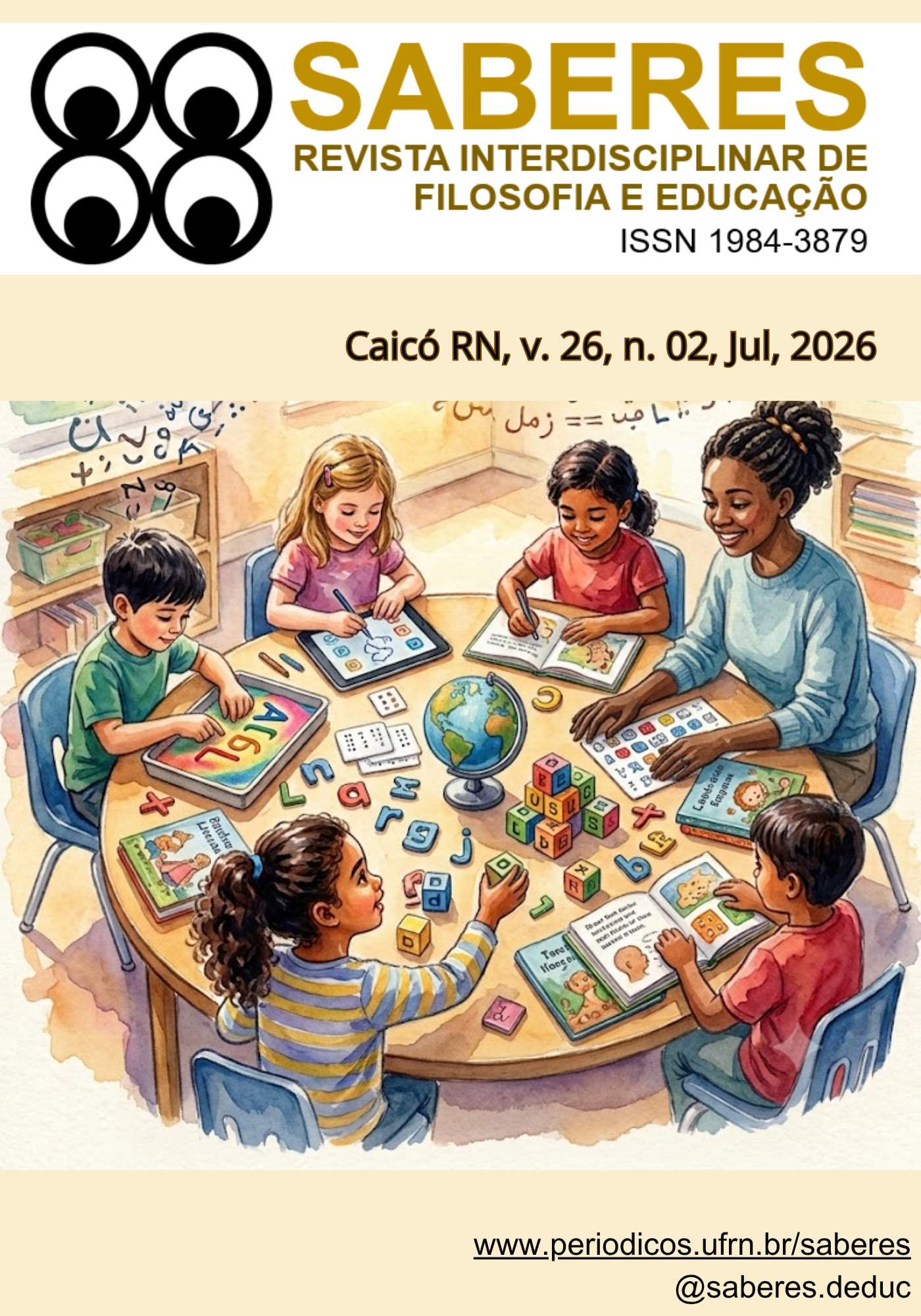
DECODING AND READING FLUENCY: EVIDENCE IN TEACHING THROUGH PHONOLOGICAL AWARENESS
EVIDÊNCIAS NO ENSINO POR MEIO DA CONSCIÊNCIA FONOLÓGICA
DOI:
https://doi.org/10.21680/1984-3879.2026v26n2ID44739Keywords:
decodificação; fluência; leitura; consciência fonológicaAbstract
Introduction: Studies show that the better the reading fluency, the more effective the comprehension of what is read. This is because decoding speed allows reading to flow more quickly, requiring more time for the reader to delve into the text's content. Phonological awareness and mastery of the alphabetic principle facilitate and facilitate the decoding process. Therefore, this study presents evidence that instruction focused on phonological awareness is fundamental to decoding and comprehension skills. Method: The study compares and analyzes the differences in reading speed of 25 pseudowords among two groups of students: five from Group A—literate based on phonological awareness and explicit instruction of the alphabetic system; and five from Group B—literate without phonological awareness and explicit instruction of the alphabetic system. Results: Differences were observed between the groups in the total reading time of the pseudowords. Group A averaged 2'53'', while Group B averaged 3'65''. Group A performed better when reading pseudowords with complex syllables, and words with CV (Consonant-Vowel) syllables appeared to be the easiest to decode in both groups. Conclusion: Teaching with an emphasis on phonological awareness and explanation of the alphabetic system facilitates initial decoding and, consequently, reading fluency. The quality of decoding influences fluency, allowing more time for reading comprehension.
Downloads
References
ADAMS, M.J. Beginning to read: thinking and learning about print. Cambridge: The MIT Press; 1991.
BREZNITZ, Z. Fluency in reading: synchronization of process. Mahwah (NJ): Lawrence Erlbaum; 2006.
BRODACZ, R. Um estudo sobre a memória de trabalho em crianças com desvios fonológicos. Porto Alegre: PUCRS, 1998. Dissertação (Mestrado em Letras), Faculdade de Letras, Pontifícia Universidade Católica do Rio Grande do Sul.
CUNHA, V. L. O.; MARTINS, M. A.; CAPELLINI, S. A. Relação entre Fluência e Compreensão Leitora em Escolares com Dificuldades de Aprendizagem. Psicologia: Teoria e Pesquisa. 2015: 33(1-8).
ECKERT, T.L.;ARDOIN, S.P.; DALY, E.J.; MARTENS, B.K. Improving oral reading fluency: a brief experimental analysis of combining an antecedent intervention with consequences. J Appl Behav Anal. 2002;35(3):271-81
LABERGE, D.; SAMUELS, S.J.Toward a theory of automatic information processing in reading. Cognitive Psychology. 1974; 6(2): 293-323. Doi: 10.1016/0010-0285(74)90015-2.
MALUF, M.R.; PULIEZI, S. A fluência e sua importância para a compreensão da leitura. Psico-USF. 2014; 19(3): 467-475.
RIGATTI-SCHERER, A.P. Princípio alfabético e consciência fonológica: fatores determinantes no tempo de leitura de crianças em processo de alfabetização. Signo. 2007; 32: 82-99.
RIGATTI-SCHERER, A.P. Consciência fonológica e explicitação do princípio alfabético: importância para o ensino da língua escrita. Porto Alegre: PUCRS, 2008. Tese (Doutorado em Letras), Faculdade de Letras, Pontifícia Universidade Católica do Rio Grande do Sul.
RIGATTI-SCHERER, A. P. O tripé da alfabetização: consciência fonológica, princípio alfabético e letramento. Revista de Estudos Linguísticos da Univerdade do Porto. Nº Especial, 2020, p. 33 -43.
SANTOS, M. T.; NAVAS, A.L. Distúrbios de leitura e escrita – teoria e prática. Barueri (SP): Manole; 2002; Aquisição e desenvolvimento da linguagem escrita. p. 1-26.
SCLIAR-CABRAL, L. Princípios do Sistema Alfabético do Português do Brasil. São Paulo: Contexto, 2003.
UNIVERSIDADE FEDERAL DE MINAS GERAIS (UFMG). Faculdade de Educação (FaE). Centro de Alfabetização, Leitura e Escrita (Ceale) - Glossário CEALE.
Downloads
Published
How to Cite
Issue
Section
License
Copyright (c) 2026 Ana Paula Rigatti Scherer

This work is licensed under a Creative Commons Attribution-NonCommercial-ShareAlike 4.0 International License.
Este obra está licenciado com uma Licença Creative Commons Atribuição 4.0 Internacional.
Autores que publicam nesta revista concordam com os seguintes termos:
a. Autores mantém os direitos autorais e concedem à revista o direito de primeira publicação, com o trabalho simultaneamente licenciado sob a Licença Creative Commons Attribution 4.0 que permite o compartilhamento do trabalho com reconhecimento da autoria e publicação inicial nesta revista.
b. Autores têm autorização para assumir contratos adicionais separadamente, para distribuição não-exclusiva da versão do trabalho publicada nesta revista (ex.: publicar em repositório institucional ou como capítulo de livro), com reconhecimento de autoria e publicação inicial nesta revista.
c. Autores têm permissão para publicar e distribuir seu trabalho online (ex.: em repositórios institucionais ou na sua página pessoal) após a publicação inicial nesta revista, já que isso pode gerar alterações produtivas, bem como aumentar o impacto e a citação do trabalho publicado (Veja O Efeito do Acesso Livre).
Foram feitos todos os esforços para identificar e creditar os detentores de direitos sobre as imagens publicadas. Se tem direitos sobre alguma destas imagens e não foi corretamente identificado, por favor, entre em contato com a revista Saberes e publicaremos a correção num dos próximos números.

 English
 Español (España)
 Português (Brasil)