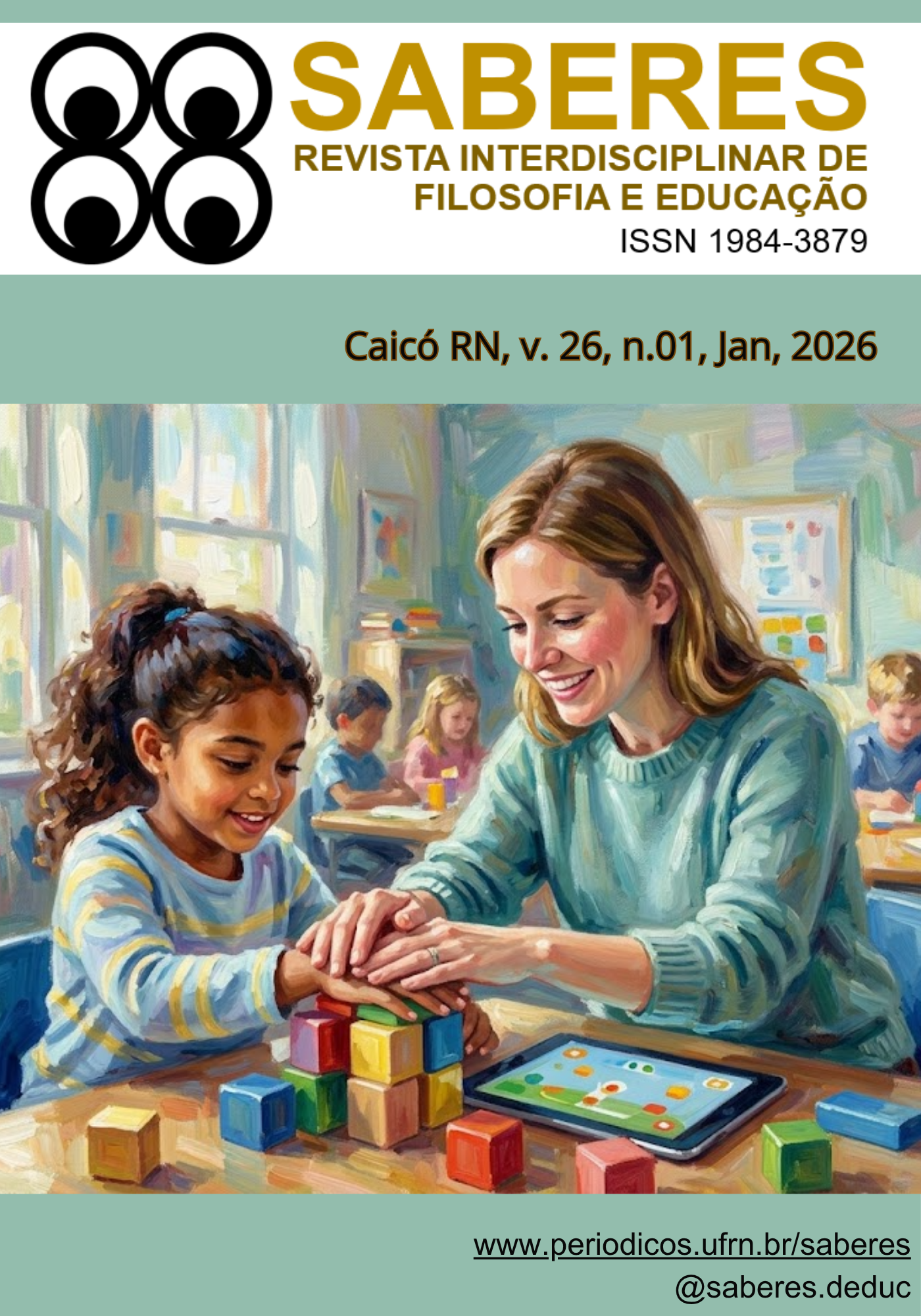
O USO DA LUDICIDADE E DOS JOGOS DIGITAIS NA EDUCAÇÃO INFANTIL
DOI:
https://doi.org/10.21680/1984-3879.2026v26n1ID42919Palavras-chave:
Educação Infantil, Ludicidade, Jogos Digitais, Aprendizagem, TecnologiasResumo
O presente artigo discute a importância da ludicidade e dos jogos digitais na Educação Infantil, destacando-os como recursos pedagógicos capazes de potencializar o processo de ensino-aprendizagem. A ludicidade é compreendida como uma dimensão essencial do desenvolvimento infantil, promovendo o aprendizado por meio do prazer, da criatividade e da interação. Fundamentada em autores como Luckesi (2002), a pesquisa evidencia que o brincar é um meio fundamental para o desenvolvimento cognitivo, social e afetivo da criança, possibilitando e evidenciando as experiências significativas que vão além da simples diversão. Os jogos digitais, por sua vez, surgem como ferramentas inovadoras que integram o aprender e o brincar, estimulando o raciocínio lógico, a atenção e a autonomia, desde que utilizados de forma planejada e intencional. O artigo também reflete sobre os desafios enfrentados no contexto escolar, como a carência de infraestrutura tecnológica e a necessidade de formação docente voltada ao uso pedagógico das tecnologias. Conclui-se que a união entre ludicidade, jogos digitais e Educação Infantil contribui para a construção de práticas educativas mais dinâmicas, criativas e significativas, promovendo um ensino humanizado e coerente com as demandas da era digital, além de abrir caminhos para novas pesquisas sobre metodologias ativas e inovações pedagógicas.
Downloads
Referências
ANDRE, Marli. O que é um estudo de caso qualitativo em educação?. Revista da FAAEBA: Educação e Contemporaneidade[online]. 2013, vol.22, n.40, pp.95-103.
AGUIAR, André Andrade de. Avaliação da microbiota bucal em pacientes sob uso crônico de penicilina e benzatina. 2009. Tese (Doutorado em Cardiologia) – Faculdade de Medicina, Universidade de São Paulo, São Paulo, 2009.
ALBUQUERQUE, C. C. B. A compreensão dos futuros educadores sobre ludicidade: (des)preparados para a atuação docente? (Dissertação de Mestrado) São João Del Rei: UFSJ, Universidade Federal de São João Del-Rei, 2012.
BRASIL. Ministério da Educação. DÚVIDAS MAIS FREQUENTES SOBRE EDUCAÇÃO INFANTIL. Brasília: MEC, 2013.
COSTA, Camila Bianca da; SILVA, Tálita Gabriela Aparecida da; FRANCATTO, Roberta Mello. Brinquedoteca uma ferramenta pedagógica. Revista Faculdades do Saber, v. 5, n. 11, p. 729-740, 2020.
DANTAS, José Alves et al. Regulação da auditoria em sistemas bancários: análise do cenário internacional e fatores determinantes. Revista Contabilidade & Finanças, São Paulo, v. 25, n. 64, p. 7-18, jan./abr. 2014. DOI: http://dx.doi.org/10.1590/S1519-70772014000100002. Disponível em: http://www.scielo.br/scielo. php?script=sci_arttext&pid=S1519-70772014000100002&lng=en&nrm=iso. Acesso em: 20 maio 2014.
FREIRE, P. Pedagogia da Autonomia: saberes necessários à prática educativa. 25. ed. São Paulo: Paz e Terra, 1996.
GIL, A. C. Como elaborar projetos de pesquisa. São Paulo, SP: Atlas, 2002.
GUERREIRO, M.A.S. Os efeitos do Game Design no processo de criação de Jogos Digitais utilizados no Ensino de Química e Ciências - O que devemos considerar? Dissertação (Mestrado em Educação para a Ciência) – Faculdade de Ciências, Universidade Estadual Paulista “Júlio de Mesquita Filho”, Bauru, 2015.
LUCKESI, Cipriano Carlos. Ludicidade e atividades lúdicas: uma abordagem a partir da experiência interna. Ludicidade: o que é mesmo isso, p. 22-60, 2002. Disponível em: https://portal.unemat.br/media/files/ludicidade_e_atividades_ludicas.pdf. Acesso em: 26 jul. 2025.
MASSA, Monica de Souza. Ludicidade: da Etimologia da Palavra à Complexidade do Conceito. APRENDER - Caderno de Filosofia e Psicologia da Educação, [S. l.], v. 2, n. 15, 2017. Disponível em: https://periodicos2.uesb.br/aprender/article/view/2460. Acesso em: 27 jul. 2025.
MINEIRO, Márcia; D’ÁVILA, Cristina. Ludicidade: compreensões conceituais de pós-graduandos em educação. Educação e Pesquisa, v. 45, p. e208494, 2019. scielo.br/j/ep/a/pfxVGbRyGr7cjhrYWzZkbFG/?format=pdf&lang=pt. Acesso em: 28 jul. 2025.
MINAYO, M. C. O desafio da pesquisa social. In: Minayo, M. C. (Org.). Pesquisa social:
teoria, método e criatividade. Rio de Janeiro, RJ: Vozes, 2009.
NARCISO, Ana Lúcia do Carmo; SÁ, Adrielle Lourenço de; FUMIÃ, Herman Fialho. A NEUROCIÊNCIA COMO EMBASAMENTO PARA A UTILIZAÇÃO DE JOGOS DIGITAIS NA EDUCAÇÃO. SAPIENS-Revista de divulgação Científica, v. 1, n. 2, 2019. Disponível em: https://www.researchgate.net/profile/Herman-Fumia/publication/370925073_A_NEUROCIENCIA_COMO_EMBASAMENTO_PARA_A_UTILIZACAO_DE_JOGOS_DIGITAIS_NA_EDUCACAO/links/64694b2cc9802f2f72eba8dc/A-NEUROCIENCIA-COMO-EMBASAMENTO-PARA-A-UTILIZACAO-DE-JOGOS-DIGITAIS-NA-EDUCACAO.pdf. Acesso em: 10 out. 2025
NOBRE, A.; MARTIN-FERNANDES, I. Abrir caminhos para a investigação em educação: design-based research. Práx. Educ., Vitória da Conquista, v. 17, n. 48, p. 234-254, out./dez. 2021. DOI: https://doi.org/10.22481/praxisedu.v17i48.8821. Disponível em: http://educa.fcc.org.br/scielo.php?script=sci_arttext&pid=S2178-26792021000500234&lng=pt&nrm=iso. Acesso em: 19 jan. 2023.
ROLIM, Amanda Alencar Machado. Uma leitura de Vygotsky sobre o brincar na aprendizagem e no desenvolvimento infantil . Revista de Humanidades , [S. l.], v. 23, n. 2, p. 176–180, 2009. DOI: 10.5020/23180714.2008.440. Disponível em: https://ojs.unifor.br/rh/article/view/440. Acesso em: 27 jul. 2025.
SAVIANI, D. Educação, práxis e emancipação humana. Práxis e Hegemonia Popular, v. 2, n. 2, p. 5-20, jul. 2017. Disponível em: https://revistas.marilia.unesp.br/index.php/PHP/article/view/10542/6556. Acesso em: 20 jan. 2023.
SCHUYTEMA, Paul. Design de Games: uma abordagem prática. São Paulo: Cengage Learning, 2011.
Downloads
Publicado
Como Citar
Edição
Seção
Licença
Copyright (c) 2026 Ítalo Anderson de Souza Silva, Kamilly Vitória de Araujo Santos, Isabela Cristina Santos de Morais

Este trabalho está licenciado sob uma licença Creative Commons Attribution-NonCommercial-ShareAlike 4.0 International License.
Este obra está licenciado com uma Licença Creative Commons Atribuição 4.0 Internacional.
Autores que publicam nesta revista concordam com os seguintes termos:
a. Autores mantém os direitos autorais e concedem à revista o direito de primeira publicação, com o trabalho simultaneamente licenciado sob a Licença Creative Commons Attribution 4.0 que permite o compartilhamento do trabalho com reconhecimento da autoria e publicação inicial nesta revista.
b. Autores têm autorização para assumir contratos adicionais separadamente, para distribuição não-exclusiva da versão do trabalho publicada nesta revista (ex.: publicar em repositório institucional ou como capítulo de livro), com reconhecimento de autoria e publicação inicial nesta revista.
c. Autores têm permissão para publicar e distribuir seu trabalho online (ex.: em repositórios institucionais ou na sua página pessoal) após a publicação inicial nesta revista, já que isso pode gerar alterações produtivas, bem como aumentar o impacto e a citação do trabalho publicado (Veja O Efeito do Acesso Livre).
Foram feitos todos os esforços para identificar e creditar os detentores de direitos sobre as imagens publicadas. Se tem direitos sobre alguma destas imagens e não foi corretamente identificado, por favor, entre em contato com a revista Saberes e publicaremos a correção num dos próximos números.
 English
 Español (España)
 Português (Brasil)