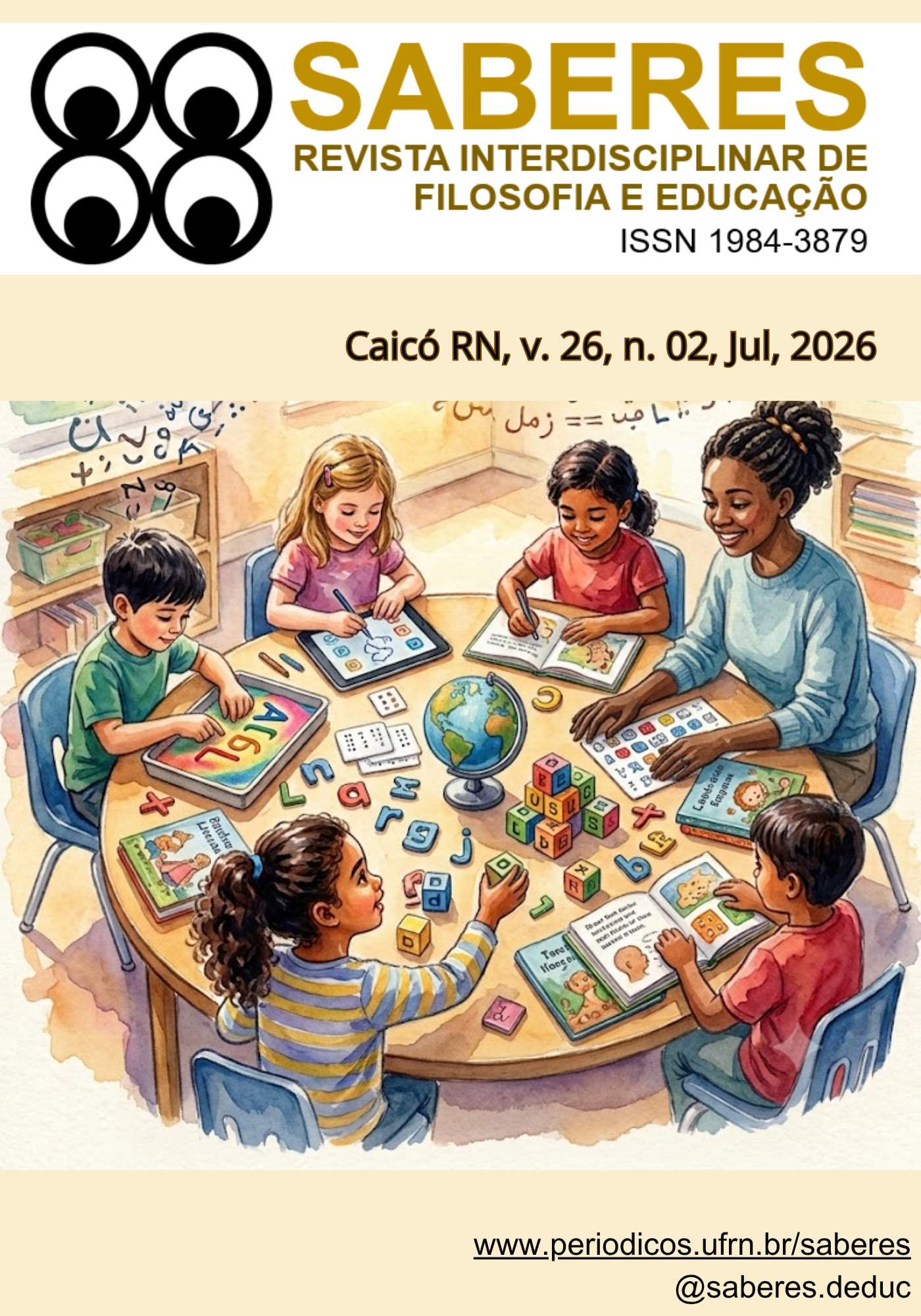
FLUÊNCIA DE LEITURA
DA TEORIA À PRÁTICA PEDAGÓGICA
DOI:
https://doi.org/10.21680/1984-3879.2026v26n2ID44736Palavras-chave:
Alfabetização; Ensino da Leitura; Fluência de leituraResumo
O interesse no domínio da fluência de leitura é relativamente recente, tendo sofrido um incremento assinalável a partir do relatório publicado pelo National Reading Panel – NRP (2000), nos E.U.A., incremento este também verificado em Portugal e no Brasil. Os principais objetivos deste artigo são analisar o contributo da fluência para a compreensão da leitura e sugerir estratégias que possam ser utilizadas para a sua promoção. Na primeira parte, é efetuada uma análise das componentes do Modelo Simples de Leitura, sendo apresentada uma breve síntese da investigação sobre o contributo da fluência para o desempenho em leitura. Na segunda parte, são mencionadas as várias estratégias que têm sido utilizadas para a promoção da fluência de leitura, sendo apresentados exemplos, para a língua portuguesa, da sua operacionalização em sala de aula. Defende-se que esta operacionalização seja feita por infusão curricular, atendendo a um conjunto de premissas: a) ser efetuada de forma sistemática; b) ser implementada de modo a evitar ao máximo a exposição pública de leitores ainda muito pouco fluentes; c) recorrer a textos com potencial motivador e adequados ao nível de proficiência que vai sendo sucessivamente atingido pelos alunos.
Downloads
Referências
BANDURA, A. Social learning theory. Englewood Cliffs, NJ: Prentice-Hall, 1977.
BOGAN, B.; BELL, D. Fluency in early childhood: Contributions from the research to support emerging and struggling readers. International Journal for Innovation Education and Research, Bangladesh, v. 3, n. º 12, p.111-121, 2015.
BORGES, M.; VIANA. F. L. Ouvintes sortudos. Um programa de promoção da fluência em leitura – 2.º ano. Lisboa: Ministério da Educação-Programa Nacional de Promoção do Sucesso Escolar, 2020. Disponível em: https://pnpse.min-educ.pt/estudo5. Acesso em: 18 nov. 2021.
CUNHA, V. L. O.; MARTINS, M. A.; CAPELLINI, S. A. Relação entre fluência e compreensão leitora em escolares com dificuldades de aprendizagem. Psicologia: Teoria e Pesquisa, Brasil, v. 3, p. 1-8, 2017. DOI:10.1590/0102.3772e33314
DEENEY, T. A. One-minute fluency measures: Mixed messages in assessment and instruction. The Reading Teacher, U.A.S., v. 63, n.º 6, p. 440-450, 2010. DOI:10.2307/25615834
DOLEAN, D. D.; LERVÅG, A.; VISU-PETRA, L.; MELBY-LERVÅG, M. Language skills, and not executive functions, predict the development of reading comprehension of early readers: Evidence from an orthographically transparent language. Reading and Writing, Netherlands, v. 34, p. 1491-1512, 2021. DOI: 10.1007/s11145-020-10107-4
FENTY, N.; MULCAHY, C.; WASHBURN, E. (2015). Effects of computer-assisted and teacher-led fluency instruction on students at risk for reading failure. Learning Disabilities: A Contemporary Journal, U.S.A., v.13, n.º 2, p. 141-156, 2015.
FERREIRA, A.; RIBEIRO, I. S.; VIANA, F. L. Avaliação de um programa de intervenção na fluência de leitura. Revista Iberoamericana de Educación, México, v. 59, n.º 4, p. 1-13, 2012.
FUCHS, D.; FUCHS, L.S.; BURISH, P. Peer-assisted learning strategies: An evidence-based practice to promote reading achievement. Learning Disabilities Research and Practice, U.S.A., v. 15, n.º 2, p. 85-91, 2000. DOI:10.1207/SLDRP1502_4
GOUGH, P. B.; TUNMER, W. E. Decoding, reading, and reading disability. Remedial and Special Education, U.S.A., v. 7, n.º 1, p. 6-10, 1986.DOI:10.1177/074193258600700104
HOOVER, W. A.; GOUGH, P. B. The simple view of reading. Reading and Writing, Netherlands, v. 2, p. 127-160, 1990. DOI:10.1007/BF00401799
HOOVER, W. A; TUNMER, W. E. The Cognitive Foundations of Reading and Its Acquisition: A Framework with Applications Connecting Teaching and Learning. Literacy Studies 20, 2020. Switzerland: Springer. DOI:10.1007/978-3-030-44195-1_5
JOHNS, J. L. Basic reading inventories (10th Ed.). Dubuque, IA: Kendall Hunt, 2008.
JOHNS, J. L.; BERGLUND, R. L. Fluency: Differentiated interventions and progress-monitoring assessments. Dubuque, IA: Kendall Hunt, 2010.
KIM, Y.-S. Why the simple view of reading is not simplistic: Unpacking component skills of reading using a direct and indirect effect model of reading (DIER). Scientific Studies of Reading, U.K., v. 21, p. 310-333, 2017. DOI:10.1080/10888438.2017.1291643
KIM, Y. S.; WAGNER, R. K. Text (oral) reading fluency as a construct in reading development: an investigation of its mediating role for children from grades 1 to 4. Scientific Studies of Reading, U.K., v. 19, n.º 3, p. 224-242, 2015. DOI:10.1080/10888438.2015.1007375
KUHN, M. R.; RASINSKI, T.; YOUNG, C. The best practices in fluency instruction. In: MORROW, L. M; L. B. GAMBRELL, L. B. (Eds.), Best practices in literacy instruction (6th ed). Guilford Press, 2018, p. 271-288.
LEE, J.; YOON, S. Y. The effects of repeated reading on reading fluency for students with reading disabilities: A meta-analysis. Journal of Learning Disabilities, U.S.A., v. 50, n.º 2, p. 213-224, 2017. DOI:10.1177/0022219415605194
LERVÅG, A.; HULME, C.; MELBY-LERVÅG, M. Unpicking the developmental relationship between oral language skills and reading comprehension: It's simple, but complex. Child Development, U.S.A., v. 89, n.º 5, p. 1821-1838, 2017. DOI: 10.1111/cdev.12861
L.R.R.C.; CHIU, Y. D. The Simple View of Reading Across Development: Prediction of Grade 3 Reading Comprehension From Prekindergarten Skills. Remedial and Special Education, U.S.A., v. 39, n.º 5, p. 289-303, 2018. DOI:10.1177/0741932518762055
MONTEIRO, C.; VIANA, F. L. Falar, ouvir e ler: um programa para o desenvolvimento da linguagem oral. Letrônica, Brasil, v. 14, n.º 2, p. 1-16, 2021. DOI: 10.15448/1984-4301.2021.2.38500.
MONTGOMERIE, R.; LITTLE S. G.; AKIN-LITTLE, A. Video self-modeling as an intervention for oral reading fluency. New Zealand Journal of Psychology, New Zealand, v. 43, p. 18-27, 2014. DOI: 10.1037/e615362013-001
NATIONAL READING PANEL [NRP]. Report of the National Reading Panel. Teaching children to read: An evidence-based assessment of the scientific research literature on reading and its implications for reading instruction. Washington, DC: U. S. Government Printing Office, 2000. Disponível em: https://www.nichd.nih.gov/sites/default/files/publications/pubs/nrp/Documents/report.pdf. Acesso em: 18 nov. 2021.
PADELIADU, S.; ANTONIOU, F. The relationship between reading comprehension, decoding, and fluency in Greek: a cross-sectional study. Reading & Writing Quarterly, U.K., v. 30, n.º 1, p. 1-31, 2014. DOI: 10.1080/10573569.2013.758932
PETSCHER, Y.; KIM, Y. S. The utility and accuracy of oral reading fluency score types in predicting reading comprehension. Journal of School Psychology, U.K.,v. 49, n.º 1, p. 107-129, 2011. DOI: 10.1016/j.jsp.2010.09.004
PRICE, K. et al. The contributions of oral and silent reading fluency to reading comprehension. Reading Psychology, U.K.,v. 37, n.º 2, p. 167-210, 2015. DOI: 10.1080/02702711.2015.1025118
PULIEZI, S.; MALUF, M. R. A fluência e sua importância para a compreensão da leitura. Psico-USF, Brasil, v. 19, n.º 3, p. 467-475, 2014. DOI:10.1590/141382712014019003009
RAND-READING STUDY GROUP. Reading for understanding toward an R&D program in reading comprehension. Santa Mónica, CA: RAND Corporation, 2002.
RASINSKI, T. V. (Ed.). Essential readings on fluency. Newark, DE: I.R.A, 2009.
RASINSKI, T. V. The fluent reader (2nd Ed.). New York: Scholastic, 2010.
RASINSKI, T. V. et al. Reading Fluency. In: KAMIL, M. L.; PEARSON, P. D.; MOJE, E. B.; AFFLERBACH, P. P. (Eds.), Handbook of Reading Research, Vol. IV. Philadelphia, PA: Routledge, 2011. p. 286-319.
RASINSKI, T. V.; PADAK, N. D. From phonics to fluency: Effective teaching of decoding and reading fluency in the elementary school. Boston, MA: Pearson, 2008.
RIPOLL, J. C. S.; AGUADO, G. A.; CASTILLA-EARLS, A. P. The simple view of reading in elementary school: a systematic review. Revista de Logopedia, Foniatría y Audiología, Espanha, v. 34, n.º 1, p. 17-31, 2014. DOI: org/10.1016/j.rlfa.2013.04.006
ROBSON, C.; BLAMPIED, N. M.; WALKER, L. E. Effects of feedforward video self-modelling on reading fluency and comprehension. Behaviour Change, U.K., v. 32, n.º 1, p. 46-58, 2015.
SPEAR-SWERLING, L.; STERNBERG, R. J. What science offers teachers of reading. Learning Disabilities Research & Practice, U.S.A., v. 16, p. 51-57, 2001. DOI:10.1111/0938-8982.00006
STEVENS, E. A.; WALKER, M. A.; VAUGHN, S. The Effects of Reading Fluency Interventions on the Reading Fluency and Reading Comprehension Performance of Elementary Students With Learning Disabilities: A Synthesis of the Research from 2001 to 2014. Journal of Learning Disabilities, U.S.A., v. 50, n.º 5, p. 576-590, 2017. DOI:10.1177/0022219416638028
SUCENA, A.; CASTRO, S. L.; SEYMOUR, P. Developmental dyslexia in an orthography of intermediate depth: The case of European Portuguese. Reading and Writing, Netherlands, v. 22, n.º 7, 791–810, 2009. DOI:10.1007/s11145-008-9156-4
THERRIEN, W. J. (2004). Fluency and comprehension gains as a result of repeated reading: A meta-analysis. Remedial and Special Education, U.S.A., v. 25, n.º 4, p. 252-261. DOI:10.1177/07419325040250040801
VEENENDAAL, N. J.; GROEN, M. A.; VERHOEVEN, L. What oral text reading fluency can reveal about reading comprehension. Journal of Research in Reading, U.K., v. 38, n.º 3, p. 213-225, 2015. DOI:10.1111/1467-9817.12024
Downloads
Publicado
Como Citar
Edição
Seção
Licença
Copyright (c) 2026 Fernanda Leopoldina Viana, Carla Fernandes Monteiro

Este trabalho está licenciado sob uma licença Creative Commons Attribution-NonCommercial-ShareAlike 4.0 International License.
Este obra está licenciado com uma Licença Creative Commons Atribuição 4.0 Internacional.
Autores que publicam nesta revista concordam com os seguintes termos:
a. Autores mantém os direitos autorais e concedem à revista o direito de primeira publicação, com o trabalho simultaneamente licenciado sob a Licença Creative Commons Attribution 4.0 que permite o compartilhamento do trabalho com reconhecimento da autoria e publicação inicial nesta revista.
b. Autores têm autorização para assumir contratos adicionais separadamente, para distribuição não-exclusiva da versão do trabalho publicada nesta revista (ex.: publicar em repositório institucional ou como capítulo de livro), com reconhecimento de autoria e publicação inicial nesta revista.
c. Autores têm permissão para publicar e distribuir seu trabalho online (ex.: em repositórios institucionais ou na sua página pessoal) após a publicação inicial nesta revista, já que isso pode gerar alterações produtivas, bem como aumentar o impacto e a citação do trabalho publicado (Veja O Efeito do Acesso Livre).
Foram feitos todos os esforços para identificar e creditar os detentores de direitos sobre as imagens publicadas. Se tem direitos sobre alguma destas imagens e não foi corretamente identificado, por favor, entre em contato com a revista Saberes e publicaremos a correção num dos próximos números.

 English
 Español (España)
 Português (Brasil)